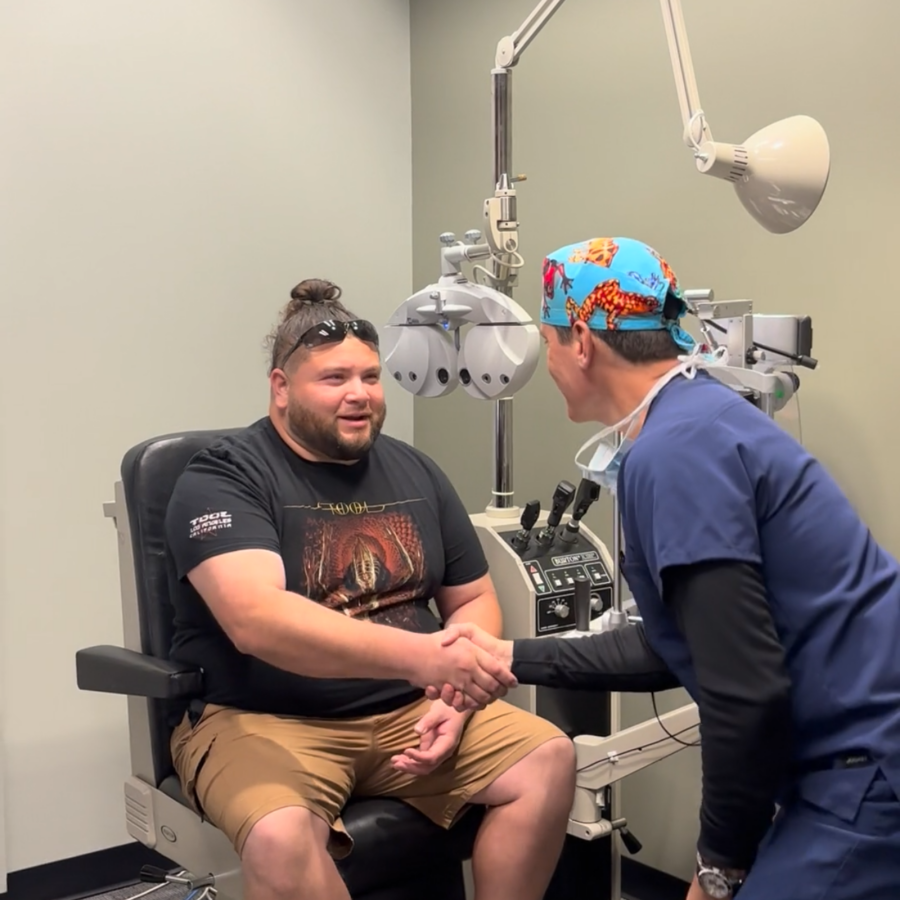
Contoura® LASIK is a type of topography-guided laser eye surgery that uses detailed maps of the cornea to help customize vision correction for eligible patients.
Contoura Vision uses specialized imaging technology to map the unique shape of the cornea, the clear front surface of the eye. These detailed measurements help the surgeon plan laser treatment based on the eye’s individual characteristics.
Unlike treatment planning based primarily on a glasses or contact lens prescription, Contoura Vision incorporates corneal topography into the process. It may be an option for eligible patients with nearsightedness, with or without astigmatism.
The surgeon reviews these measurements alongside your prescription, corneal health, and other factors to determine whether Contoura LASIK is an appropriate option.
What Are the Benefits of Contoura LASIK?
Contoura Vision offers a topography-guided approach to LASIK, using detailed corneal measurements to help tailor treatment to each eye.
Potential benefits include:
Personalized treatment planning: Corneal surface mapping provides additional information to help guide the surgeon’s treatment plan.
Correction of certain vision errors: It may be an option for eligible patients with nearsightedness, with or without astigmatism.
Potential improvements in visual quality: Research has found improvements in certain visual outcomes and patient-reported symptoms following treatment, but individual results vary.
Reduced dependence on glasses or contacts: As with other forms of LASIK, the goal is to reduce the need for corrective lenses for everyday activities.
Contoura LASIK is not automatically the best choice for every patient. Your prescription, corneal shape, overall eye health, and surgeon’s evaluation all matter when determining the most appropriate treatment.
Who Is a Candidate for Contoura LASIK?
Contoura Vision may be an option for adults who want to reduce their dependence on glasses or contact lenses and meet the medical requirements for laser vision correction.
Potential candidates generally need a stable prescription and healthy eyes. The surgeon will also evaluate corneal thickness, corneal shape, prescription, and other factors that could affect safety and results.
Contoura Vision is intended for certain prescriptions, including nearsightedness with or without astigmatism. Having astigmatism does not automatically rule you out, but not every type or degree of astigmatism is suitable for every treatment.
A comprehensive consultation is the best way to determine whether Contoura LASIK, another form of LASIK, or a different vision correction option may be appropriate for you.
Contoura LASIK vs. Traditional LASIK
Both Contoura LASIK and traditional LASIK use laser treatment to reshape the cornea and improve how light focuses on the retina. The key difference is how the treatment is planned.
Traditional LASIK may use a patient’s prescription and other measurements to guide treatment.
Contoura Vision adds detailed topographic mapping of the corneal surface to help customize the treatment plan.
Neither approach is right for everyone. The best option depends on your individual measurements, prescription, eye health, and the surgeon’s assessment.
Is Contoura LASIK Worth It?
Contoura LASIK may be worth considering if you want a personalized approach to laser vision correction and are a suitable candidate for topography-guided treatment.
However, more advanced customization does not automatically mean better results for every person. During your consultation, ask your surgeon which treatment they recommend for your eyes, why it is appropriate for your prescription, what results you can reasonably expect, and what risks or limitations apply.
Understanding the differences between available procedures can help you make an informed decision based on your vision needs rather than technology alone.
What Is Contoura LASIK Recovery Like?
Contoura LASIK recovery is generally similar to recovery from other LASIK procedures. Many patients notice improved vision within the first day, although clarity can fluctuate while the eyes heal.
Your surgeon will explain when to resume driving, working, exercise, and other activities. You will also receive instructions for using prescribed eye drops, protecting your eyes, and attending follow-up appointments.
Recovery and visual results vary from person to person. Temporary dryness, glare, halos, light sensitivity, and other visual symptoms can occur after LASIK. Follow your surgeon’s instructions and report symptoms that concern you.